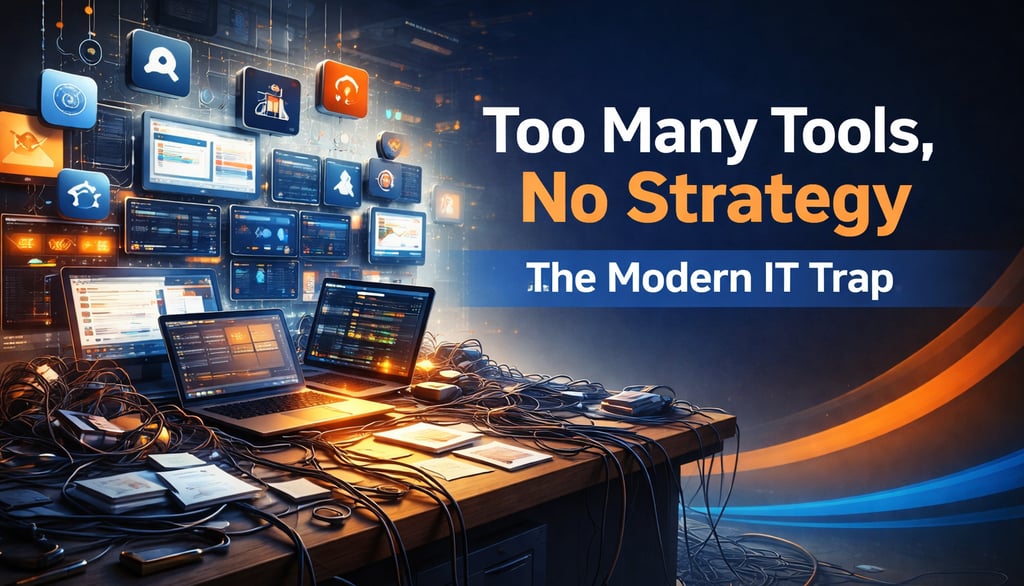
Too Many Tools, No Strategy: The Modern IT Trap
Arnaldo Toledo
In today’s technology-driven world, companies are investing in tools faster than ever before. New platforms promise efficiency, automation, security, and growth, all just a subscription away.
Yet, despite this explosion of technology… Many organizations are not becoming more efficient.
They’re becoming more complex.
The Illusion of Progress
Buying new tools often feels like progress.
A new CRM.
A new security platform.
Another collaboration tool.
Yet another dashboard.
Each decision is usually made with good intentions:
Solve a problem quickly
Keep up with competitors
Respond to internal pressure
But over time, something subtle happens:
👉 Tools start to replace strategy
How Companies Fall Into the Trap
The “too many tools” problem doesn’t happen overnight. It builds gradually.
1. Problem-by-Problem Decisions
Instead of stepping back and defining a long-term strategy, companies react to individual issues.
Need better communication? Add a tool
Security concern? Add another tool
Reporting gap? Add another platform
No one stops to ask:
👉 How do all these pieces fit together?
2. Lack of Ownership
Without clear IT leadership, tool decisions are often decentralized.
Different teams adopt different solutions:
Marketing uses one platform
Sales uses another
IT tries to connect everything afterward
The result? A fragmented ecosystem.
3. Vendor-Driven Roadmaps
Many organizations unknowingly let vendors shape their strategy.
Instead of asking:
👉 “What does our business need?”
They follow:
👉 “What does this tool offer?”
The Hidden Costs of Too Many Tools
At first glance, more tools seem like more capability.
In reality, they often create:
❌ Operational Complexity
Systems don’t integrate properly. Data lives in silos.
❌ Higher Costs
Multiple subscriptions, overlapping features, hidden redundancies.
❌ Security Risks
More tools = larger attack surface + inconsistent controls.
❌ User Frustration
Employees waste time navigating systems instead of doing meaningful work.
❌ Lack of Visibility
Leaders can’t get a clear, unified view of performance.
The Real Problem Isn’t the Tools
Let’s be clear:
Tools are not the enemy.
The real issue is the absence of a strategy.
Technology should support business goals, not define them.
What Strategic IT Actually Looks Like
A strategic approach flips the equation:
Instead of:
👉 “What tool should we buy?”
You start with:
👉 “What are we trying to achieve?”
From there:
Define clear business outcomes
Map processes
Identify gaps
Then, and only then, select the right tools
Less Tools, More Impact
High-performing organizations don’t necessarily have more tools.
They have:
✔ Better alignment
✔ Cleaner architecture
✔ Stronger governance
✔ Clear ownership
They focus on integration, simplification, and purpose.
Where Leadership Makes the Difference
This is where many companies struggle.
Without senior IT leadership (like a CIO or Fractional CIO), it’s difficult to:
Challenge unnecessary tools
Say “no” to quick fixes
Build a long-term roadmap
Align IT with business strategy
Final Thought
The modern IT trap isn’t a lack of technology.
It’s too much technology without direction.
Before adding your next platform, pause and ask:
👉 Is this solving a real problem, or adding another layer of complexity?
Because in the end…
It’s not about how many tools you have. It’s about how well they work together to drive your business forward.
© 2026 Toledo Digital Consulting. All rights reserved