Governing the AI Era: How COBIT, ITIL, and ISO 27001 Enable Secure and Scalable Digital Transformation 🚀`
Arnaldo Toledo
4 min read
Introduction 🤖
Artificial Intelligence is rapidly redefining the enterprise technology landscape. From predictive analytics 📊 and autonomous operations ⚙️ to generative AI 🧠 and intelligent automation, organizations are entering an AI-driven transformation era that promises unprecedented innovation and competitive advantage.
However, the acceleration of AI adoption introduces new risks and complexities ⚠️. CIOs must simultaneously:
Enable rapid digital innovation 🚀
Ensure operational stability 🛠️
Protect enterprise data and intellectual property 🔐
Manage AI governance, ethics, and compliance 📜
In this environment, the challenge is not only technological—it is organizational and governance-driven 🏢.
This is where established frameworks such as COBIT 2019, ITIL, and ISO/IEC 27001 become more relevant than ever 📚.
Rather than slowing innovation, these frameworks provide the structural foundation 🏗️ and guardrails necessary to scale AI safely and sustainably across the enterprise.
AI Transformation Requires Governance, Not Just Technology 🧩
Many organizations initially approach AI transformation as a technology initiative. In reality, AI adoption is fundamentally a governance and operational challenge.
AI systems introduce new concerns:
Algorithmic transparency and accountability 🔍
Data governance and model integrity 📊
AI security and adversarial attacks 🛡️
Ethical use of automation and decision systems ⚖️
Regulatory compliance and digital trust ✅
Without clear governance structures and operational discipline, AI initiatives can quickly create shadow AI environments 🌑, uncontrolled risks, and fragmented digital architectures.
A mature IT organization must therefore balance innovation velocity ⚡ with governance rigor 📏.
The Strategic Role of Each Framework in the AI Era 🎯
COBIT 2019: Governing AI and Digital Value Creation 🧠
In the AI era, COBIT 2019 provides the strategic governance framework that ensures emerging technologies align with enterprise objectives and risk tolerance.
For CIOs, COBIT enables:
Governance of AI investments and digital initiatives 💼
Alignment between AI strategy and business outcomes 🎯
Oversight of data governance and algorithmic accountability 📊
Enterprise risk management for AI and automation ⚠️
Through its governance objectives and performance management approach, COBIT ensures that AI initiatives are not isolated experiments 🔬 but integrated components of enterprise strategy.
➡️ This allows organizations to move from AI experimentation to scalable AI governance.
ITIL: Operationalizing AI-Driven Digital Services ⚙️
As AI capabilities become embedded within digital products and internal operations, organizations must manage AI-enabled services as part of the enterprise service ecosystem.
This is where ITIL becomes essential.
AI-driven environments introduce new operational requirements:
Managing AI-based service components 🧩
Monitoring automated decision systems 👀
Handling AI incidents and model failures 🚨
Managing changes in continuously learning systems 🔄
ITIL practices such as:
Incident Management 🚑
Change Enablement 🔧
Service Level Management 📈
Monitoring and Event Management 📡
Enable organizations to operationalize AI services reliably and at scale.
Additionally, ITIL’s continual improvement model ♻️ supports the iterative nature of AI systems, where models must constantly evolve based on new data and operational feedback.
➡️ ITIL provides the operational discipline necessary for AI-powered service ecosystems.
ISO 27001: Protecting Data, Models, and Digital Trust 🔐
AI systems are fundamentally data-driven, which makes information security even more critical.
ISO 27001 establishes a structured Information Security Management System (ISMS) that protects:
Training datasets 📂
Machine learning models 🧠
Intellectual property 💡
Sensitive enterprise data 🔐
Digital infrastructure 🌐
In the AI era, ISO 27001 helps organizations address emerging security challenges such as:
Data poisoning attacks 🧪
Model theft and adversarial AI 🕵️♂️
Unauthorized access to training data 🚫
Leakage of proprietary algorithms 📉
By embedding security controls across governance and operations, ISO 27001 ensures that AI innovation does not compromise enterprise security or digital trust.
The Power of Integration: Innovation with Guardrails 🛤️
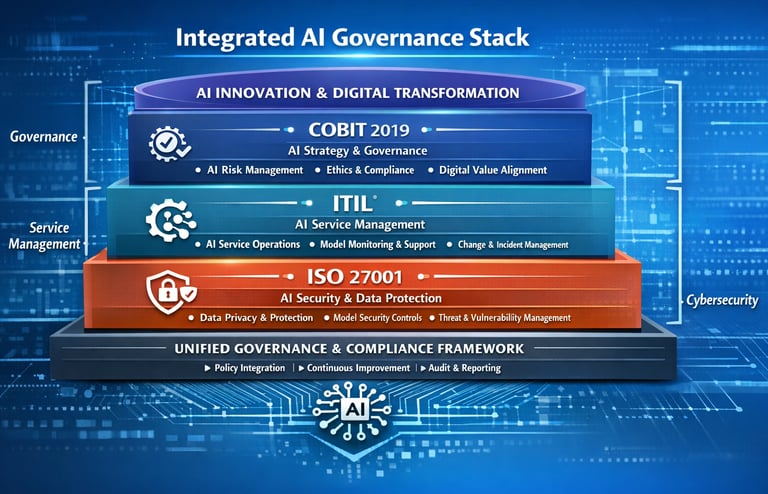
When combined strategically, these frameworks create a comprehensive operating model for AI-driven organizations.
Together, they provide a balanced model where innovation can scale without sacrificing governance or security ⚖️.
In practical terms:
COBIT defines the governance structure 🏛️
ITIL ensures operational reliability ⚙️
ISO 27001 secures the digital foundation 🔐
➡️ This integration becomes essential as organizations adopt AI platforms, automation, and intelligent digital ecosystems.
Enabling Responsible AI and Digital Trust 🤝
One of the most significant challenges of the AI era is ensuring responsible and trustworthy AI deployment.
The integration of these frameworks helps organizations establish key capabilities:
AI Governance 🧠
COBIT enables CIOs to define governance mechanisms for:
AI ethics and accountability ⚖️
Data governance 📊
Oversight of AI decision-making systems 👁️
Secure AI Development and Operations 🔐
ISO 27001 ensures AI systems are developed and operated securely by embedding:
Access controls for datasets and models 🔑
Secure development environments 🧪
Continuous risk assessment 📉
Reliable AI-Driven Services ⚙️
ITIL ensures that AI services are delivered with operational maturity, including:
Monitoring model performance 📈
Managing automated system failures 🚨
Maintaining service reliability 🛠️
➡️ Together, these practices create trustworthy AI environments that can scale across the enterprise.
Accelerating Digital Transformation with Structured Frameworks 🚀
Digital transformation initiatives often fail because organizations focus on technology deployment rather than organizational maturity.
The integration of these frameworks helps CIOs address critical transformation challenges:
Strategic Alignment 🎯
Operational Scalability 📦
Security and Compliance 🔐
Continuous Innovation ♻️
➡️ Structured improvement cycles allow organizations to evolve technologies rapidly without losing governance control.
From IT Departments to Digital Innovation Platforms 🏗️
In the AI era, IT organizations are no longer just service providers—they are innovation platforms that enable intelligent business capabilities.
By integrating COBIT 2019, ITIL, and ISO/IEC 27001, CIOs can transform IT into:
A governed digital innovation engine ⚙️
A secure platform for AI adoption 🔐
A trusted partner for business transformation 🤝
➡️ This integrated approach allows organizations to move confidently into the AI era while maintaining the discipline required to protect enterprise value.
Conclusion 🧠✨
Artificial Intelligence is accelerating the pace of digital transformation across industries 🌍. Yet innovation without governance can introduce significant operational and security risks ⚠️.
The integration of COBIT 2019, ITIL, and ISO 27001 provides CIOs with a powerful framework ecosystem that balances innovation with control ⚖️.
Together, they enable organizations to:
Govern AI initiatives strategically 🎯
Operate intelligent digital services reliably ⚙️
Protect data, algorithms, and infrastructure 🔐
In the emerging AI-driven economy, organizations that successfully combine innovation, governance, and security will not only adopt new technologies—they will build resilient and trustworthy digital enterprises 🏆.
© 2026 Toledo Digital Consulting. All rights reserved